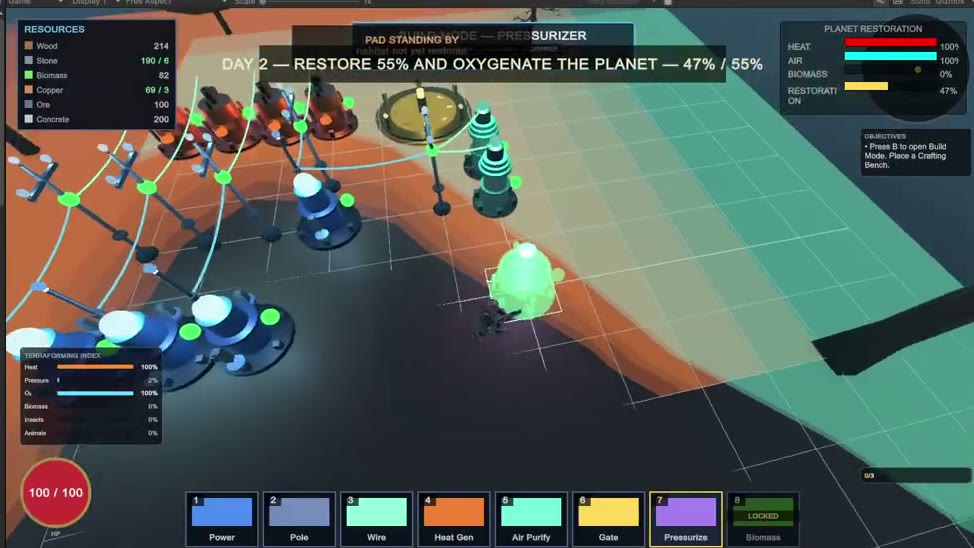
A game shape is the answer to a single question: what is the player doing in the next 60 seconds, the next 5 minutes, the next session, and the next 30 hours? If those four answers don’t compose into one story, you don’t have a game — you have a feature list.
For Aftercode, those four answers are:
- 60 seconds — mining, scanning, shooting, placing.
- 5 minutes — establish a forward outpost (extractor + power + small shelter).
- 30 minutes — advance the Terraforming Index by one rung or restore one biome patch.
- 30 hours — atmospheric stages all met + ≥ N biomes restored → build the Earth Beacon → broadcast Earth.
That’s the whole game. Three concentric layers feeding into one cinematic finale.
The three pillars below are the loops that generate those layers. Each is a complete game on its own; the magic is the overlap zone where they collide.
Pillar I — Atmospheric Terraforming
This is the slow-value loop. The Terraforming Index is a six-stage ladder:
Heat → Pressure → Oxygen → Biomass → Insects → Animals
You advance it with industrial machines: heaters, atmospheric processors, biomass cultivators. Each stage takes hours. Each rung shifts the world — sky thickens, ice retreats, the first green creeps into the soil.
This is also where the per-biome restoration lives. Each biome on the planet has its own apex — the boss-tier creature that holds the biome in failure-state. Drop the apex, deploy the seed pod, and the biome flips: native flora returns, then insects, then small animals, then larger.
The reference here is Planet Crafter. The thing Crafter gets right is that the world visually changes as you advance. The 60-second loop is unchanged (mine, scan, place), but the world looks different every hour, which keeps a long session from going stale.
Pillar II — Modular Base + Automation
This is the systems loop. Sockets, grids, power networks, conveyor chains.
The kit is a Satisfactory-style modular set: walls, floors, doors, conduits, stairs. You snap them onto a 1m grid. Multi-floor placement works. Power flows through producer → node → consumer chains, and any wall + roof combination is a “shelter” the storm system respects.
Past T1 storms (the Local rain-of-rocks variety), you’ll need thicker walls. T3 walls survive Global storms — the rare planet-wide events that hit raid-tier hard. Building tier becomes a progression axis on its own.
Automation chains let you walk away from a process. Drop an extractor on an ore deposit, run a conduit to a refiner, run that to a terraformer. Walk back two hours later. The terraformer has produced its tick.
The reference here is Satisfactory. The thing Satisfactory gets right is persistence. Your factory keeps running. The 30-minute loop ends with a moment of “I just walked back to the base and it’s working without me” — and that’s a feeling no other genre in 2026 produces as cleanly.
Pillar III — Light Extraction Combat
This is the fast loop. Five sci-fi damage types — Kinetic, Plasma, Cryo, EMP, Radiation — across an agnostic 8 + 8 hotbar (8 primary slots + 8 secondary, toggle to swap).
Combat is light. 2–5 hits per fight, Torchlight-style. Native fauna is sparse from drop. Introduced fauna is added through biome restoration — so the planet you bring back to life will have more enemies in it than the planet you started on, which is a beautiful inversion of the survival-game default.
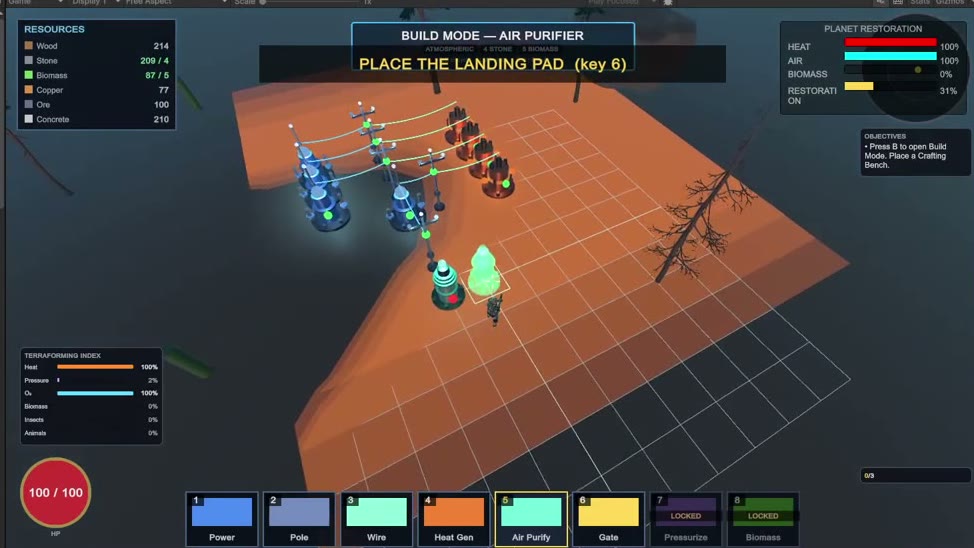
Defense is buildable. Turrets are placement-mode entities, not skill-cast ones. You build them where you need them, you wire them to your power grid, and they hold the perimeter while you scan. You can also field-deploy scout turrets — small, single-use, single-purpose.
The reference here is Riftbreaker / Helldivers 2. The thing those games get right is camera and hit-feel. Top-down camera. Mouse-aim. Shots feel weighty without being slow.
The overlap zone
Each pillar is a loop. The interesting part is what happens at the seams.
Terraforming × Building. Atmospheric machines are base buildings. Placing a heater both advances Stage 1 of the TI and consumes power from your grid. Choosing where to put one is a building decision that has terraforming consequences.
Building × Combat. Defense walls + turrets + power. A storm rolls in; your perimeter holds only if your generator chain is still feeding the wall lights. Combat happens to your base, not just away from it.
Combat × Terraforming. Per-biome restoration starts with dropping the apex. The bigger your atmosphere, the more fauna spawns in restored biomes. Combat scales with your terraforming progress, not with a difficulty slider.
The center of all three is Storms:
- Local storms — per-biome, frequent, sudden onset, ~60 seconds. Light damage to outdoor structures. Tests your shelter.
- Global storms — planet-wide, rare, raid-tier event. Heavier and longer. Tests your entire outpost network.
Storms are the only “pacing” mechanic — there’s no day/night gate, no hunger, no oxygen meter, no thirst. Just storms and the slow drumbeat of TI progress.
What this shape isn’t
It is not an open-world MMO with quests. It is not a survival game with vitals. It is not a roguelite with runs. It is not a strict colony sim with hundreds of NPCs.
It’s three loops, one world, one beacon. That’s the bet.
What’s next
Per the roadmap, the systems for all three pillars are landing through R4 (atmosphere/storms/biomes), R5 (Satisfactory-grid building), R6 (power), R7 (defenses), and R8 (Earth Beacon). R6 just shipped; R7 is in flight; R8 has the multi-stage broadcast designed but unbuilt.
The next post in this series is on combat shape specifically: Notes on top-down ARPG combat in 2026 — what I learned reading Riftbreaker, Helldivers, and Torchlight side by side.
Or, if you want the next devlog automatically: the newsletter.