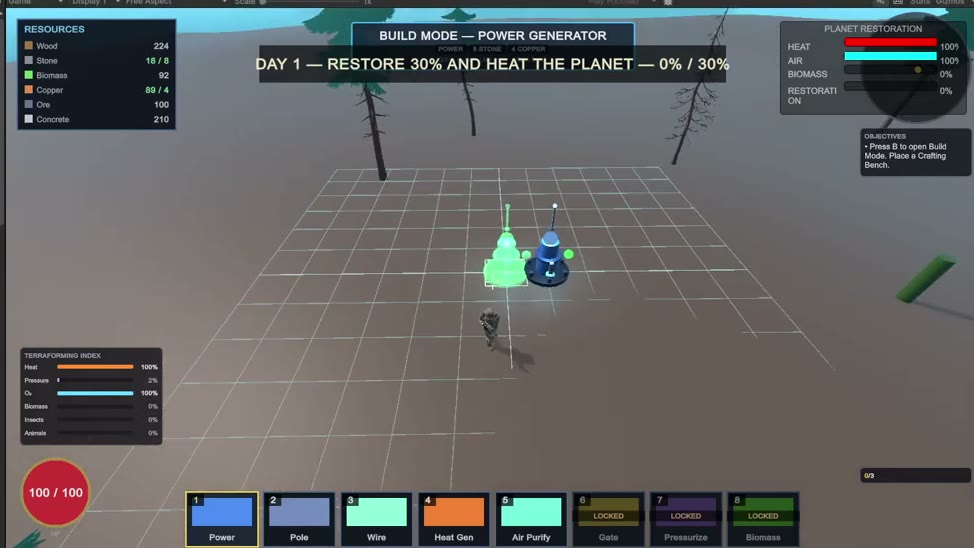
The short version: Aftercode is no longer an open-world ARPG. It’s a top-down atmospheric-terraforming game with light extraction combat. The Kickstarter-targeted vision is Planet Crafter × Satisfactory × Riftbreaker, with Subnautica’s “broadcast Earth” endgame.
The long version is what this post is about.
The old framing
Eighteen months ago, when this repo started, the pitch was: “top-down ARPG, sci-fi setting, base-building bolted on, light survival flavor.” The combat was the lead loop. Loot, stats, dungeons, hub town, vendors, NPC quests. Diablo + Helldivers in a blender.
I built a lot of that. There’s a hub scene with a quest-giver. There’s a vendor with a buyback multiplier. There’s a procedural dungeon runner with three boss phases. There’s a stat-aggregation pipeline with 14 axes that folds equipment + boons + meta upgrades into one EquippedStats struct.
It works. The combat-feel is good. The animator blend tree is satisfying. The dungeon runner shipped clean.
It’s also not the game I want to make in 2026.
What forced the rethink
Three things came together at once.
One: I played Planet Crafter through to credits. Then Satisfactory. Then Subnautica. Then Riftbreaker. And I realised the loops in those games — the slow loops where you advance a planet’s atmosphere by half a percent over an hour, or build an automated rocket-fuel pipeline that runs while you’re sleeping — were the loops I kept coming back to in my own dev sessions when I should have been building dungeon content.
Two: I noticed that every interesting mechanic I was building under the “ARPG” umbrella was secretly a terraforming mechanic in disguise. Heat statuses → atmospheric heat. Cold biome → cold biome. Power conduits in the dungeon → power conduits in a base.
Three: Solo dev. ARPGs need enormous content layers — dozens of items, boss patterns, tilesets, encounter tables. Terraforming games need a systemic layer — a few interlocking systems that produce hours of emergent play. The second is a much better fit for one developer with a Unity 6 LTS license and Claude Code as a pair programmer.
The new triangle
The pitch I now use to evaluate every system:
Planet Crafter for the atmospheric ladder and slow-value progression. Satisfactory for socket-based modular building and automation chains. Riftbreaker / Helldivers 2 for the top-down extraction-combat feel.
Tied together by storms as the pressure mechanic and the Earth Beacon broadcast as the endgame.
Three pillars, one world. The full breakdown lives in Three loops, one world.
What’s preserved
A lot more than you’d think.
- The PlayerController, animator blend tree, and locomotion stay verbatim.
- The status-effect pipeline (PlasmaBurn, Cryo, EMP) reframes to sci-fi — the underlying state machine is unchanged.
- The hotbar primitives survive. Slot 1 used to be Fireball; now it’s Power Generator. The slot logic doesn’t care.
- The base-building primitives were mostly already there from the late ARPG work — I’d been building snap-to-grid scaffolding for Phase 15 turret placement.
- Audio, particles, world streaming, inventory — all genre-agnostic.
What’s cut
Per the R2 plan, these die:
- Heat (the ARPG difficulty knob — different concept from atmospheric heat).
- Boons (Hades-style end-of-room blessings).
- Meta-Cores (between-run permanent upgrades).
- NPC quests + dialogue + hub town.
- Vendors, gold, wallet (no economy — terraforming progress is the score).
- Dungeon runner (a procedural dungeon doesn’t fit a planet you’re trying to fix).
The endgame
This is the part I’m most excited about. Subnautica’s emergence-of-the-Aurora moment, the moment you realise the game has been building toward broadcasting a signal home, is one of the cleanest endgames in the medium.
Aftercode’s version: stages of the Terraforming Index all met + N biomes restored → build the Earth Beacon → multi-stage broadcast under storm + fauna pressure → cinematic of the colony ship arriving.
The win condition is coupled to the work you’ve been doing the whole game. You can’t shortcut it, you can’t grind around it, and the moment it triggers is the moment your entire run resolves into “yes, this planet is worth living on.”
What this means for the next 6 months
The roadmap (R2 through R10) is on the homepage. R2 (tear-out) is happening now; R7 (defenses) is the current in-flight phase. The order is deliberate — every R-phase has to ship something demonstrable before the next one starts, so I can’t get six phases deep on a wrong assumption.
If you want to follow along: the newsletter gets the next devlog automatically. If you want to back the build: Patreon is open.
The next post is the three-pillars deep-dive. It’s the design rationale for the new shape.